5 reporters hurt in conflict over ex-President’s monument in Taiwan
Posted by
,
No Comments
Saturday, December 8, 2007
Before the Ministry of Education removed the title the “Gate of Great Centrality and Perfect Uprightness” along the Chiang Kai-shek Memorial Hall, members of the public and politicians from Pan-Greens and Pan-Blues battled and demonstrated there, but 5 reporters were hit by a truck near the National Central Library when they made a SNG live report.
According to witnesses and Chien-chiang Wang from Formosa Television, they witnessed the driver deliberately stepping on the accelerator after he hit a reporter and braked. Even though the suspect, Sheng-lou Peng was under arrested by the police, he caused the public indignations and was punched by a protester.
Due to the incident, politicians from Pan-Greens and Pan-Blues argued for the responsibilities again. Eventually, a legislative candidate named Feng Mei maliciously said: “It’s a show, SO WHAT?!” This behavior without respects on hurt reporters caused outrages from voters from Pan-Greens and Pan-Blues and Mei’s neighborhoods.
Politicians from two coalitions like Premier of the Republic of China Chun-hsiung Chang, KMT 2008 Presidential Candidate Ying-jeou Ma, Magistrate of Taipei County Hsi-wei Chou, Minister of the Government Information Office Chih-wei Hsieh, and current President of the Republic of China Shui-bian Chen all criticized on this incident and hoped 5 hurt reporters can recover soon.
September
14
Wednesday, August 29, 2007
An English lawyer has pleaded guilty to perverting the course of justice. He faked a legal judgment and sent it to a father who was pleading in Taunton family court to be able to remain involved in his child’s upbringing. The lawyer, London barrister Bruce Hyman, now awaits his sentence. The judge indicated that he could receive a prison sentence. Bruce Hyman is well-known in media circles, having produced The Hitchhiker’s Guide to the Galaxy on BBC Radio. He also produced a series with Clive Anderson, at Above the Title Productions, called Unreliable Evidence.
The father, a former City financier, had attended a series of court hearings in order to make suitable arrangements to see his child following an acrimonious divorce. Shortly before one of these hearings he received an email, ostensibly from a self-help group to which he belonged, which had attached a Court of Appeal case that appeared favourable to an application he had made for the judge to stand down from the case. The father, who was representing himself, duly showed the case to the judge. At this point, Bruce Hyman, the lawyer representing the former wife, claimed to the judge that the case was a forgery, which indeed it turned out to be.
After confirming that the self-help group had not sent him the email, the father then embarked on some detective work his own. The fraudulent email was traced via its header to a dial-up internet connection and a phone number belonging to a shop in London. The shop was able to recover CCTV footage which showed a man sending the email from an Apple laptop. The man turned out to be Bruce Hyman.
Sentencing of Hyman is due in Bristol Crown Court on the 19th of September.
September
11

Submitted by: Marie-Eve Boudreault
Mom, Dad, I m bored! What can we do?
You re getting pretty much bored these days being a stay-at-home parent, and your child doesn t know what to do too? Or you need fresh ideas to make some changes in your routine? Here are great tips to put magic in your days!
1. Prepare to have fun
Get up before your little one and prepare all you need depending on what you want to do. By having all ready you will be more relaxed during the day and ready to grab fun moments.
2. Vary the magic
Change what does not tempt you today. No cereals, fine. Reheated pizza (like an organic and veggie one, it s best to eat healthy food) for breakfast, why not? Your child wants to wear clothes out of the ordinary? Let him – and do it too you might like it!
Find how you can change every part of your routine. Dancing doing the dishes or sweeping may be a movie clich but it’s really more fun and there is every chance that your child will do so too!
3. It’s time for a special activity!
Ask yourself what you liked to do when you were young? An indoor playhouse done with blankets it s raining? Build a camp in the woods? Your child will be excited and you will rediscover your joyfulness.
You can go out at activity centers specially designed for children too. But the memorable moments don t have to be expensive.
4. Have your own fun time
Ask yourself what would excite you today and keep at least an hour to do it. Watch a movie, take a class, a beer with friends?
5. Accomplish yourself once and for all
I know that without using my potential and helping others to be happy, I get bored. That’s why I started writing and make available the website Blissful Stay-At-Home Parent. I’m busy but I like my life!
What are you lacking in your life? Do you have a dream that you re waiting to do? Follow your passions and start your project step by step – you’ll be amazed at the results when we roll up our sleeves and do it at last!
6. Carpe Diem
Now is the only time you have. That’s right! “Seize the day”, live fully, savor the pleasures of life.
7. Think of fun instead of…
You should not be reluctant to do a stay-at-home parent task, complain about the weather or be too serious. Remember to have some fun in everything you do and see what is positive everywhere. Your moral will be uplifted, contagious and you will be an inspiration for other people, including your child. But precisely, your child may be your best model to show you how to have fun with everything.
P.S. Why “kick boredom far away” in the title? Because I felt myself like having fun and variety in writing this article! Stay tuned for other great titles…
For more high-quality information on being a mother or father at home and improve your lives, thanks for visiting “Blissful Stay-At-Home Moms and Dads” website! At http://www.stay-at-home-parent.com
About the Author: You can use it for your site! But include this : Marie-Eve Boudreault is a sociologist and the author of the website and ebooks on how to be Blissful Stay-At-Home Moms and Dads. Improve your life by subscribing to her ezine and get 2 free ebooks as a bonus ”10 Tips to Be A Blissful Stay-At-Home Parent” and ”Activities For Bored Kids”, a limited double offer! Articles, ebooks, exclusive stay-at-home parent forum, and more at
stay-at-home-parent.com
Source:
isnare.com
Permanent Link:
isnare.com/?aid=893652&ca=Family+Concerns
Monday, October 1, 2007
Brian Jackson is running for the Ontario Liberal Party in the Ontario provincial election, in the Oxford riding. Wikinews’ Nick Moreau interviewed him regarding his values, his experience, and his campaign.
Stay tuned for further interviews; every candidate from every party is eligible, and will be contacted. Expect interviews from Liberals, Progressive Conservatives, New Democratic Party members, Ontario Greens, as well as members from the Family Coalition, Freedom, Communist, Libertarian, and Confederation of Regions parties, as well as independents.
September
10
Thursday, September 14, 2006
The 2006 Liverpool Biennial art festival will start its ten week run on September 16, finishing on the November 26. The exhibition uses public places located across the city.
Installation will be situated at sites across the city including St. George’s Hall and Church of St Luke with specialist centers such as the Bluecoat Arts Centre, FACT centre, Tate Liverpool and the Walker Art Gallery providing exhibition space.
The international ’06 exhibition includes 35 commissioned works, while the 24th John Moores Exhibition of Contemporary Painting is the UK’s longest running open painting competition.
The Independents is an art exhibition that runs alongside the Biennial. Several shorter festivals will run over this period including the Hope Street festival.
September
8
Muscle Gain Truth Review – Does This No Fail System Help You Build Lean Muscle Naturally?
by
Dean James
If you are looking for a guide that shows you how to build muscle mass the natural, drug-free way, read on. In this Muscle Gain Truth review we are going to cover how this No Fail system by Sean Nalewanyj works, who it’s best suited to and whether it is an effective system for helping you build lean muscle mass.
What Is Muscle Gain Truth?
It’s an ebook that does away with myths commonly associated with gaining muscle mass. If you happen to be one of those people spending a lot of cash on ergogenic aids, expensive supplements or even drugs to assist you in your quest to bulk up, get ripped or push past your genetic boundaries, you will find this guide to be a real eye-opener.
Muscle Gain Truth asserts the case that in order to build muscle mass, you do not need to engage in steroid use or purchase expensive supplements to get the muscular body that you want. It does, however, require that you are willing to do your work-out and exercise to facilitate the growth of lean muscle.
What Makes This Guide Different To The Rest?
The Muscle Gain Truth guide reveals what truly works to build muscle mass and what things are a waste of your valuable time. Many supplements in the market today don’t offer the assurance that they are really effective, often offering minimal proof or sometimes even none at all. The Muscle Gain Truth guide skips all this confusion by providing you with all natural methods that work and don’t require the use of any drugs or overpriced food supplements.
Does It Work?
This program is also known as the “No Fail System”. It’s suitable for anyone that wants to build lean muscle mass naturally. Also people that may have found it hard to gain muscle in the past will benefit from the methods taught in this guide as it tells you what foods you should be eating and what exercises you should be doing when you are working out in order to stimulate faster muscle growth and achieve the physique you crave even more quickly. With this program you won’t have to spend a fortune on equipment or wait years in order to see tangible results.
What Does Muscle Gain Truth Contain?
The main part of this program is the muscle building manual which is over 250 pages in length and crammed with detailed and actionable steps for natural muscle building. There are also a generous number of complimentary extras included with the package such as the 26 week workout plan, muscle mass meal plans and exclusive members access to a video database that shows you tons of different weightlifting exercises. There are also half a dozen free bonuses as well. There is also a Gold edition which includes even more than the basic package, full details of which are included on our website.
Muscle Gain Truth Review – Conclusion
This is a great value, low cost muscle building program which is ideal for anyone that wants to learn the truth about building muscle mass using all natural methods. This guide focuses on eating the right foods and performing the most effective exercises to get results. It represents great value when you take into account all the extras included with the package and it offers a healthy solution to putting on size faster to achieve the muscular physique you’ve always wanted. Anyone that has ever previously struggled to put on muscle will find this program offers them the natural shortcut to success that they have been looking for.
By now you will see that this program is an effective way to build muscles safely and naturally. Read our FULL consumer
Muscle Gain Truth Review
which includes feedback from previous customers and details of everything you get with this muscle building system when you purchase at =>
Muscle Mass Building Programs
Article Source:
Muscle Gain Truth Review – Does This No Fail System Help You Build Lean Muscle Naturally?
Tuesday, January 19, 2010
Officials from France and Germany have warned people against using Microsoft’s Internet Explorer, citing security holes, and encouraged users to find an alternate browser to surf the Internet.
The government agency Certa, which oversees cyber attacks and security, warned against using all versions of Internet Explorer. Officials from Germany had warned last Friday against the browser when malicious code was published on the Internet.
“Pending a patch from the publisher, Certa recommends using an alternative browser,” Certa said in a statement.
Graham Cluley, from the security firm Sophos, said that the weakness had only been exploited in IE6, but he noted that “Microsoft themselves admit there is a vulnerability, even in IE8.” He noted that, since more information into the malicious code is now available on the internet, hackers could alter the code to make it affect other versions of the browser.
The head of Microsoft’s security and privacy department, however, commented that “the risk is minimal. There are very few of them out there,” adding that in order for a computer to be infected by a virus, it would have to be running IE6 and be on a compromised website. “If you look at other browsers, it’s likely they will have other vulnerabilities,” he said to the BBC. “We feel strongly that IE8 is most secure browser on the market.”
Microsoft encouraged users to upgrade to IE8, which they described as the “most secure browser on the market”.
The firm is working on a patch to fix the problem, however, a spokesman said there wasn’t any specific timeframe for its release.
Wednesday, November 22, 2006
The 1999 and 2000 year model Honda Civic SiR tops the list of Canada’s most stolen cars.
Consumer popularity also assures the cars will be popular with thieves. Its the second year in a row the Honda SiR has topped the list.
Rick Dubin Vice President of Investigations for the Insurance Bureau of Canada said “The Civics are easy targets.”
Dubin said that once stolen, the cars are most often sold to “chop shops” where thieves completely dismantle the vehicles. The automobile’s individual parts are worth more than the entire car.
The sheer numbers of the cars and their lack of theft deterrent systems make them thieves’ preferred choices.
1999 and 2000 Honda Civics do not come with an electronic immobilizer, however all Hondas from 2001 and onward are equipped with an immobilizer. Immobilizers will be mandatory on all new cars sold beginning September 2007. The devices enable an engine computer to recognize an electronic code in the key. If the code in the key and the engine don’t match exactly, the vehicle can’t be started.
In third place was the 2004 Subaru Impreza, while the 1999 Acura Integra came in fourth, with the 1994 Honda Civic rounding out the top five.
In sixth place, the 1998 Acura Integra, and the 1993 Dodge Shadow completed seventh.
When asked why early model vehicles are selected, he said that, “auto thieves continue to find it easier to steal older vehicles lacking an IBC-approved immobilizer. We’ve seen this trend developing for several years, and these results confirm it.”
Another Honda automobile, the 1996 year model Civic filled eighth place, with the 2000 German Audi TT Quattro in ninth.
The American 1996 Chevrolet/GMC Blazer rounded out the top ten.
None of the above cars had an electronic immobilizer.
September
5

By Willie Jones
If you can read and understand what all the ingredients are in your shampoo and conditioner bottles then congratulations! You are one of a very small percentage of people who can do this. For the rest of us, we seem to go on blind faith that the manufactures know what they are doing. But what are they really? Below is a broad overview of some of the most common ingredients you’ll see on these labels.
Sodium Lauryl Sulfate:
This substance is derived from coconut alcohols. It is a surfactant which is anything that allows oil to mix with water which has a slight negative charge to it. It reduces the surface tension between it and water and is used in shampoos for normal to oily and oily hair. Other surfactants are; ammonium lauryl sulfate, ammonium laureth sulfate, sodium laureth sulfate, potassium coco hydrolyzed collagen and disodium laureth sulfosuccinate.
Isopropyl Alcohol:
This substance is derived from petroleum and is a drying agent. Isopropyl alcohol should not be left on the scalp for too along as it can start taking off the top layer of skin. This can leave the scalp susceptible infections.
Propylene Glycol Distearate:
This is crystallized stearic acid and ethylene glychol which gives your shampoo that mother of pearl look and feel. It is a common thickening agent in hair dyes and shampoos and has humidifying effects on hair and scalp.
Disodium EDTA:
This is a substance is a chelating agent that gives shampoo products a stable look and feel to it. This product, as with some of the others, must not be left on the scalp for long as it has the ability to go deep down into the skin allowing for more chemicals to potentially reach the blood stream.
Cetearyl alcohol:
Ceterayl or cetyl alcohol is made from coconut oil and is used as an emulsifier. This is what makes your hair feel like velvet. Where the glycol distearate makes the shampoo look creamy and pearl like, the cetearyl alcohol makes the hair feel silky smooth.
The Good:
These ingredients do several things. They act as a detergent for cleaning dirt, oil and debris from hair, it also provides conditioning for your hair and it is the foaming agent that makes us feel like we are really cleansing the hair and scalp. They can make your hair feel velvety soft, absorb oils or make dry hair feel moist.
The Bad:
These are all chemicals that can be absorbed into the skin and hair. Many of the chemicals in shampoo products are petroleum or alcohol based some of which are the same products used to make antifreeze or garage floor cleaners to name a few.
The Ugly:
There may be health risks associated with all of the above chemicals. They all have the potential to be absorbed into the scalp and down to the bloodstream where they can be deposited into major organs such as the brain, eyes, heart, lungs, kidney and liver where they can remain for quite some time causing damage. One needs to be especially mindful that children of all ages avoid getting these chemicals in the eyes as they may cause potential permanent damage. Skin irritation or allergic reactions can occur with prolonged use and in some cases (such as with disodium EDTA) can have carcinogenic effects on the body.
More People are getting health conscious about processed foods and are avoiding them, but how about all these chemicals? They are processed as well and although they may all stem from nature, the processing changes the chemical structure to the point where the body does not recognize what it is.
If you decide to use these ingredients, all I can suggest is that you shampoo and rinse quickly so as to avoid absorption as much as possible. Better still, Find chemical free cleansing shampoos and conditioners and avoid possible contamination altogether!
About the Author: Willie is a researcher and freelance writer whose own health problems prompted her to gain as much information on health and wellness as possible and relay it to others. She is co-owner of http://www.nutrition-tips.com a site dedicated to health and hair care products.
Source: isnare.com
Permanent Link: isnare.com/?aid=277636&ca=Wellness%2C+Fitness+and+Diet
18 December 2004
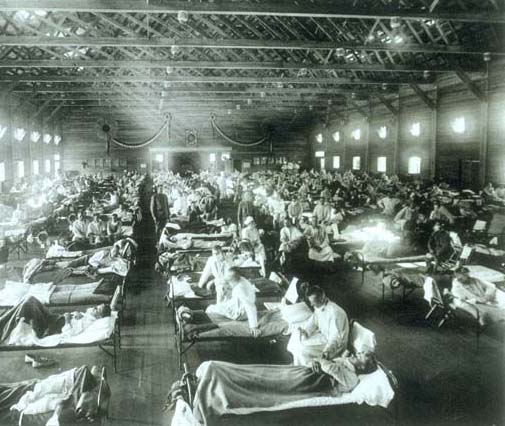
Emergency hospital during 1918 influenza epidemic, Camp Funston, Kansas (source: National Museum of Health and Medicine, AFIP).
A bout of the flu can be mild. In young, healthy adults, many infections pass unnoticed. But sometimes the influenza virus evolves into a strain that decimates its victims. The worst known strain swept the world in the Fall of 1918, infecting 500-1000 million and killing 40-100 million, about 2-5% of people.
There are several theories about where the pandemic began, but the likeliest origin was in Haskell County, Kansas, in the United States. People in the sparsely populated county, where farmers raised pigs, poultry, cattle, and grain, began suffering from influenza in late January 1918. Unusually for flu, it was young, healthy adults who were hardest hit. Victims fell ill suddenly, many progressing to pneumonia and dying, often within days. Within weeks, however, the epidemic ended. The natural geographic isolation of this community normally might have contained the fatal flu in a sort of unintentional quarantine, but the First World War intervened. Men were uprooted from their home towns and congregated in huge numbers in army camps for training and then shipping out to other camps or to fight in Europe. The destination for men from Haskell County was Camp Funston, part of Fort Riley, Kansas, where the first influenza case was reported in early March. As soldiers moved among camps, the virus spread. Within two months, the epidemic spread to most of the army camps and most of the largest cities in the United States. As American soldiers went to France, so did the virus, spreading first from the port of Brest.
The flu then spread worldwide. The pandemic reached its height in the Fall of 1918. Spain was affected early, and because Spain was not fighting in the World War, there was no wartime censorship, and news of the outbreak became widely known, leading to the flu being called the Spanish Flu in many countries. In Spain, however, it was called French Flu or the Naples Soldier. In India, about 12 million people died of flu. In some US cities, people died so quickly that morticians couldn’t cope with the bodies. According to Jessie Lee Brown Foveaux, who worked in the Fort Riley laundry during the epidemic: “They were piling them up in a warehouse until they could get coffins for them.”
The disease started with cough, then headache. Temperature, breathing and heart rate increased rapidly. In the worst cases, pneumonia came next, the lungs filling with liquid, drowning the patients and turning them blue from lack of air. Patients bled from every orifice: mouths, noses, ears, eyes. Those who survived often suffered temporary or permanent brain damage. Several million developed encephalitis lethargica, in which victims were trapped in a permanent sleeplike and rigid state, as portrayed in the 1990 movie “Awakenings.” In others, normal thought processes were impaired. During negotiations to end World War I, US President Woodrow Wilson was struck with flu, and people around him noted that his mental abilities never fully recovered. The French leader George Clemenceau had wanted harsher punishment of Germany than Wilson had desired. Clemenceau may have convinced Wilson in his weakened state to accept such harsh terms, which may have been one of the factors causing World War II.
Since flu is highly contagious early in the illness, even before symptoms appear, strict quarantine may be necessary to stop its spread during an epidemic. Australia kept its 1918 flu death rate relatively low by enforcing quarantines. However, in many parts of the world, public health officials hesitated to impose such measures, giving the disease time to gain a foothold. In the US city of Philadelphia, a rally of half a million people was planned in September 1918 to sell bonds to fund the war, at just the time when the flu started to infect residents. Although doctors warned the public health director to cancel the rally, he wanted to meet the city’s quota to raise money for the war and refused to cancel the event. Within days after the rally, half a million city residents caught the flu.
Why was the 1918 flu so deadly? The influenza virus wasn’t preserved at the time of the outbreak, at least on purpose. But in the late 1990s researchers Ann Reid, Jeffery K. Taubenberger, and their colleagues extracted and sequenced the genetic material of the virus, RNA, from tissue of victims who died in the pandemic. They used bits of lung that were preserved in formalin from victims on army bases or from victims buried in permafrost in the Alaskan village of Brevig Mission, where flu killed 85% of adults. Comparisons with known flu viruses in humans, pigs, and birds suggest that some genes of the 1918 virus came from birds or an unknown animal source. Other scientists then were able to show that the amino acid sequence of hemagglutinin protein from the 1918 virus had several changes from other flu viruses that may have helped it to easily bind and invade human cells, and that made the virus look different enough from earlier flu virus strains that people had no immunity.
The possibility exists that another flu pandemic will sweep the world like the one in 1918. In 2004, an H5N1 influenza virus has killed millions of birds and at least 30 people in southeast Asia. So far this virus strain has not evolved the ability to pass directly from human to human, but that possibility becomes more likely as the bird flu pandemic continues and humans remain in contact with chickens, ducks, and other birds. The virus has killed two-thirds of people reported to be infected. Dr. Tim Uyeki, an epidemiologist for the US Centers for Disease Control, says, “you have the ingredients in Asia right now for a public health disaster.”
But since sequences of this bird flu virus are known, it may be possible to develop a vaccine or set of vaccines to protect against it. At a special meeting of influenza experts on November 11th and 12th, World Health Organization influenza program chief Klaus Stohr said, “It is not only possible, but also important, that influenza pandemic vaccines be made available… and there’s a shared responsibility needed to make that happen…. We have a huge window of opportunity now.”